Chester from Manchester: The Complete Walls, the Rows, and a Clock’s Unprovable Claim
An hour west, Chester keeps the most complete city walls in Britain — two free miles that explain the whole town — plus medieval shopping galleries stacked two storeys high and a clock with a claim nobody can check.
The short version
- Trains run Manchester to Chester in about an hour at steady frequency — nationalrail.co.uk — with the walls reachable in ten minutes from the station.
- The walls are the alarm’s itinerary: a nearly complete two-mile circuit — Roman foundations, medieval heights, Georgian promenading — walked free at rooftop level with the city, river, and racecourse organizing themselves below.
- The Rows run the four main streets in two storeys: street-level shops below, a continuous covered gallery of shopfronts above — a medieval retail arrangement surviving nowhere else at this completeness, browsed today as naturally as it was in 1350.
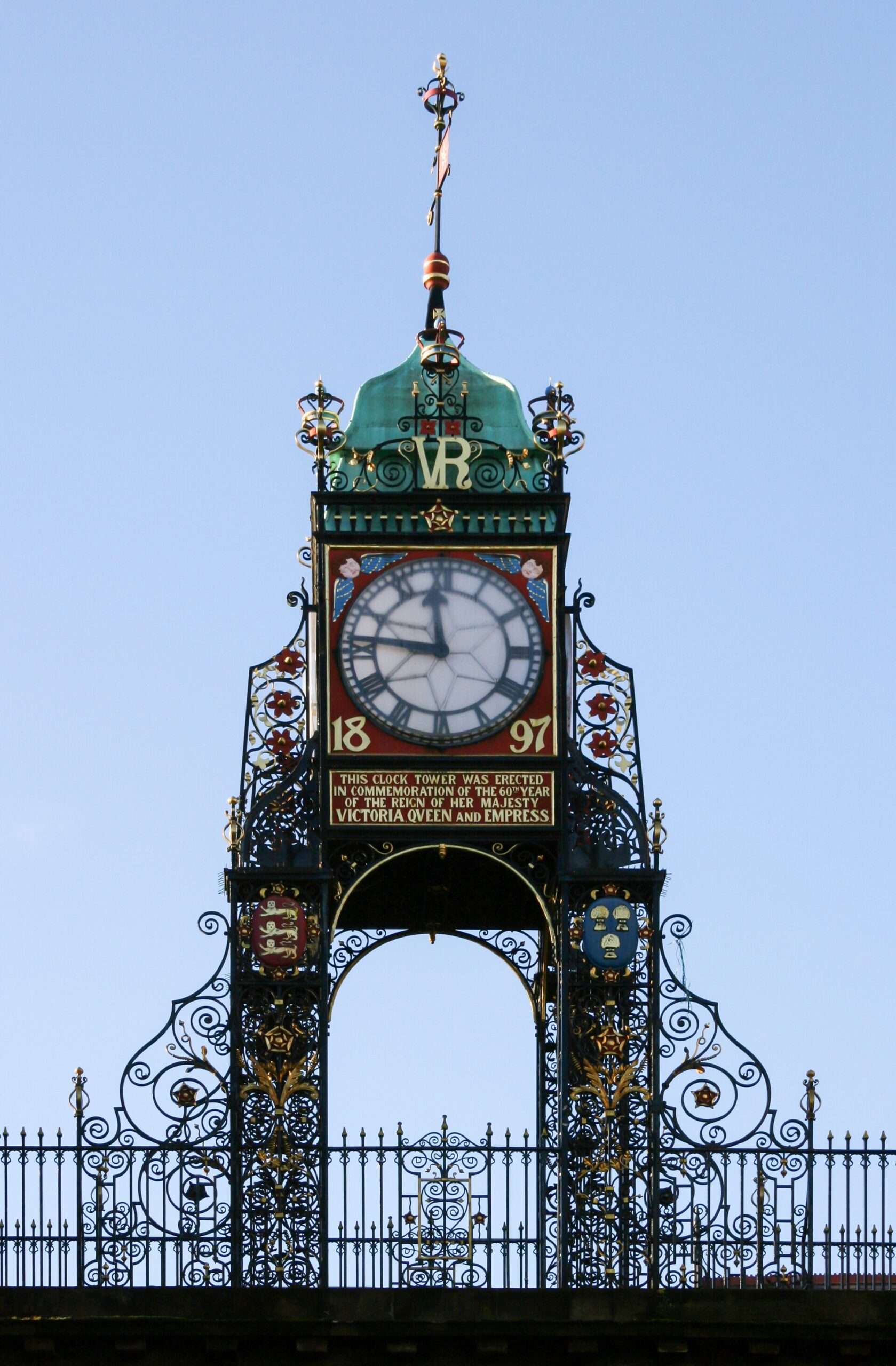
- The Eastgate Clock — the filigree turret over the wall’s eastern gate, raised for Victoria’s 1897 jubilee — carries its most-photographed-after-Big-Ben claim per the alarm: unprovable, unfalsifiable, and civically cherished.
- Roman Chester surfaces on schedule: the amphitheatre outside the walls is Britain’s largest, free and open; the Roman Gardens line up salvaged columns below the wall walk, and the Grosvenor Museum holds the tombstone collection.
- The cathedral’s red sandstone adds the quiet hour — monastic cloisters and medieval quire carving — and the Roodee below the walls runs racing on Britain’s oldest working course by its own claim, with race days re-costuming the whole town.

Getting there
The hourly-pattern trains make Chester a turn-up day from either Manchester station; the alarm’s walls-first order starts at the Eastgate steps ten minutes’ walk away. Race-day dates at the Roodee change the trains’ population and the town’s dress code — worth knowing before choosing the date, whichever reaction you’re after. The circuit-then-center structure needs no tickets anywhere; Chester is the network’s cheapest full day in Britain.
The day
Climb at the Eastgate and walk the circuit clockwise: the clock overhead first, the cathedral’s flank, the canal drop at Northgate, King Charles’ Tower where the king watched his army lose, the river corner past the Old Dee Bridge, and the Roodee’s green oval below the western stretch — two miles that hand you the city’s whole plan, per the alarm’s promise. Descend into it: the Rows’ upper galleries browsed along Watergate and Bridge Street (the crooked timberwork is Victorian revival atop genuine medieval bones — the town is honest about the mix), lunch in a gallery café or at the market hall. The afternoon takes the amphitheatre’s free arc, the Roman Gardens, and the cathedral’s cloisters, with the riverside’s boat-and-ice-cream register closing the loop at Grosvenor Park. The clock’s photograph happens whenever you pass under it, which the town has already counted.
When to go
Chester runs year-round — the walls in winter mist have their partisans, and the Rows are weatherproof by design. Summer brings the full riverside-and-racing season; the Christmas market dresses the square from mid-November. Race days (May through September pattern) flood the trains with fascinators and the pubs with consequences — a spectacle to join or a crowd to dodge, chosen knowingly. Midweek mornings own the wall circuit in any month.
Frequently Asked Questions
Are the walls really complete?
Nearly — the circuit runs unbroken save short street-level interruptions, which no other British city matches. Roman work shows at the base courses, medieval above, and the walkway itself is a Georgian promenade: three eras underfoot in two miles.
How medieval are the Rows really?
The arrangement and many undercrofts are genuinely 13th–14th century; much visible black-and-white timberwork is Victorian revival raised on those bones. The town states the mix plainly, and the browsing experience — unique regardless of the timber’s date — is the point.
Is the amphitheatre impressive?
As archaeology, yes — Britain’s largest, seating estimates around 8,000, half-excavated with the rest under listed buildings. As spectacle it’s a grassed arc with excellent interpretation: come for the story, not gladiator theater.
What happens on race days?
The Roodee — racing since the 1500s by the standing claim — runs its May-to-September meetings below the walls, and the town converts: dressed crowds, booked tables, singing trains home. The wall’s western stretch becomes a free grandstand, which is the visitor’s cheat.
Chester or the Peak District from Manchester?
The Peak (documented on this network) for hills and air; Chester for walls, Rows, and Rome at zero exertion. Boots versus browsing — an hour’s train either way, and the forecast is an honest tiebreaker.